
Investing in the Space, the Time, and the Journey
February 26, 2019 | Read Time: 6 minutes

Babson alumnus, Arthur M. Blank ’63 H’98, is the co-founder of The Home Depot, owner of the Atlanta Falcons, and chairman of The Arthur M. Blank Family Foundation. The Blank Foundation seeks to move people and communities beyond what seems possible today and, in that, support social value creation, entrepreneurship, connection to and protection of the natural environment, and the development of values-based leaders.
In line with that commitment, it wanted to provide a transformative experience to a small cohort of nonprofit leaders in the two locations where the Blank Foundation is most deeply engaged: Georgia and Montana. Instead of sending leaders to yet another conference, it wanted to create a truly remarkable experience. It partnered with Babson College to create a new executive education certificate program, Entrepreneurial Leadership in the Social Sector, at West Creek Ranch, its new facility in Montana’s Paradise Valley.
Ambitious missions, complex needs
Eleven nonprofits were chosen from a larger group of applicants, based on carefully considered criteria. One key requirement was that each organization send a team representing top leadership, including the executive director and a board member.
Those selected were leading nonprofits with ambitious missions and a desire to learn new approaches, not only for addressing the social issues to which they are committed, but also for developing their own capacity as entrepreneurial leaders. This matters more than ever today, as we watch unpredictable and disruptive dynamics render traditional approaches ineffective. The social sector needs creative, resourceful leaders with new thinking and more diverse skills for solving complex problems.
An integrated mindset for problem-solving
Designing and leading the program were two positive disruptors: Cheryl Kiser and Cheryl Heller (forever named “the Cheryls” by the team and cohort at West Creek Ranch). Kiser, the executive director at The Lewis Institute at Babson College, has spent more than a decade helping entrepreneurs and leaders create and scale social value. Heller, who founded the first MFA program in social design at the School of Visual Arts, has spent years guiding people into a new kind of creative leadership.
The uniqueness of this design is the integration of two distinct disciplines, Babson’s Entrepreneurial Thought & Action® (ET&A™) and Social Design. This ecosystem approach to immersive learning combines the principles, processes, and skills of both disciplines to foster creativity, agency, resourcefulness, and strategic capacity.
The Blank Foundation’s six core values were built into this new curriculum, which moves participants from ideology to action and outcomes.
Actively participating, actively learning
Participation began long before the cohort came together. Each organization received a series of foundational questions delving into who they are, why they chose to participate, their hopes for the program, what keeps them up at night, and what excites them. Each was asked to describe their current state of transition or growth and to reflect on what’s at stake for their organization, their community, and their constituency.
From the application process to the end of the program, participants knew that this would not be a passive experience. A successful learning community does not include bystanders. Participants would be creating outcomes in community with each other, even though each had different starting points, challenges, goals, and needs.
Nature-inspired immersive learning
By the time the group assembled at the end of July, 21 social sector leaders, two educators, and an extraordinary team of co-creators from West Creek Ranch and the Blank Foundation were well prepared to create a transformational three-day learning journey.
A source of learning, inspiration, solace, and community was the place itself. The physical beauty of West Creek Ranch and the inspiration for its creation were crucial aspects of the learning context. It provided a magical environment for engaging with others, reflecting, creating, and recreating.
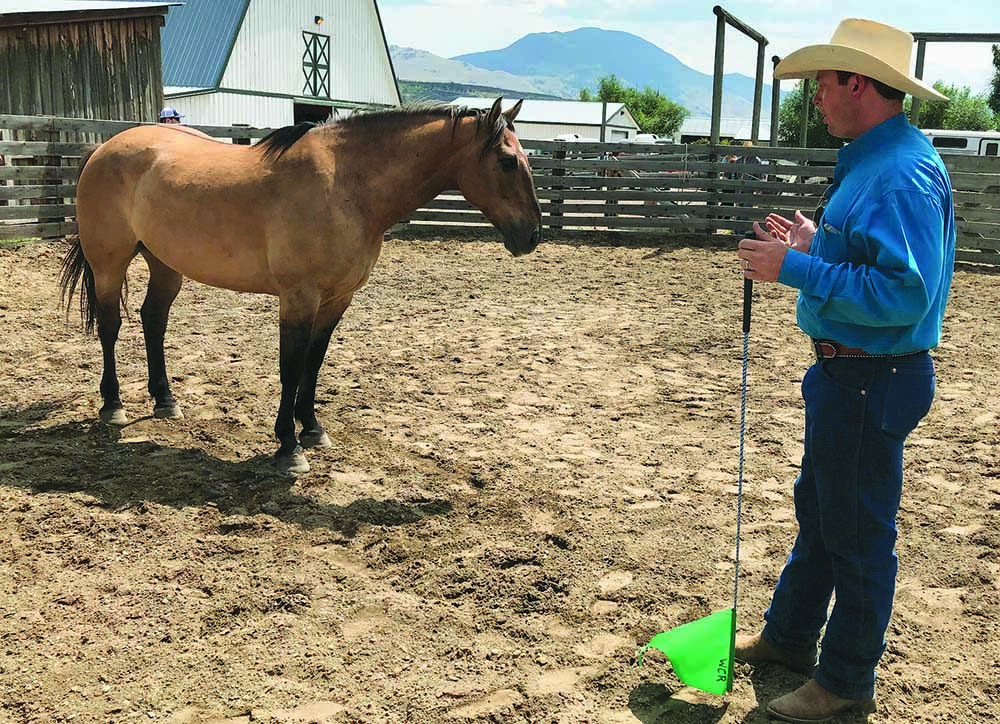
Whitney Tilt, director of land and wildlife conservation for the foundation, led guided nature walks filled with lessons on the health interdependency of ecosystems, as well as inspiration for how to be creative in identifying resources. Terence Eichhorn, the chief wrangler, gave a breathtaking demonstration of how precise communication and understanding can exist between creatures with little in common — in this case, a man and his horse, Whiskey. In each case, participants extrapolated the lessons for leadership and the creation of economic and social value.
The arc of the week was calibrated carefully to move toward program goals, even though individual activities were wildly diverse and often unexpected. Sessions took place in classroom settings, outdoors on ropes courses, hiking along mountain streams, while dining at family-style meals, or during warm campfire nights. Everything was done with intention, and every bit mattered.

Practicing what we teach
Both entrepreneurship and social design rely on a leader’s ability to notice what is needed in a given context, rather than sticking to plans or formulas imported from other places and times. The West Creek Ranch experience required the Cheryls to adapt the program to meet the participants’ changing needs. They continually refined the curriculum as they learned more about the organizations, evolving the program based on the progress made and opportunities discovered. The seamless integration of staff, guests, instructors, wranglers, conservationists, chefs, musicians, and animals (no bears showed up, but lessons were learned about them nevertheless) contributed to a generative willingness to pivot on a moment’s notice, depending on the needs of the group.
Creating the conditions for change
Those of us whose jobs are about challenging the status quo, managing some of the toughest social dilemmas of our time, and navigating uncertainty need to be facilitators of a creative, entrepreneurial process. No one foundation, social-sector organization, company, or government can solve the magnitude of dilemmas that are defining our global environment. We need to be actively creating the conditions by which solutions can emerge.
Some philanthropists and leaders are shifting their orientation, taking a more entrepreneurial and design-focused approach to gifting and social impact. The commitment the Blank Foundation made with Babson to accelerate the leadership capacity of its grantees has set in motion a powerful lever for developing the skills required for creative leadership in any sector. As a result of our learnings at West Creek Ranch, Babson has developed an expanded program called “Creating Economic and Social Value in Uncertain Times,” for any organization dedicating itself to the UN Global Goals. We urgently need a new approach to collaboration and aligned action to benefit the Earth and its inhabitants. We believe that these principles for solving complex problems hold the key.