
Roots or Parachutes
September 30, 2019 | Read Time: 10 minutes
How do you design an annual event to exemplify an organization’s embrace of new-power principles?
At Independent Sector, a membership organization that has represented America’s largest foundations and nonprofit organizations for nearly 40 years, this was an especially salient and challenging question for incoming CEO Dan Cardinali. With a background in community organizing, Cardinali believed that a new-power shift was largely about meaning-making — that more voices and more diverse voices would help to create a conscious awareness of the sector’s identity and possibility. Of course, Independent Sector had other vehicles for meaning-making — including policy, communications, and programs — but the annual convening seemed like the perfect place to signal that an important shift was underway.
Who’s in the room? How do they show up? Who gets heard? Those were the key questions for a new-power convening, and authentic answers would require a whole new design process, with key decisions turned over to community stakeholders — quite a departure for a conference that had been largely designed “inside the Beltway” for its entire history.
Designing a New-Power Event
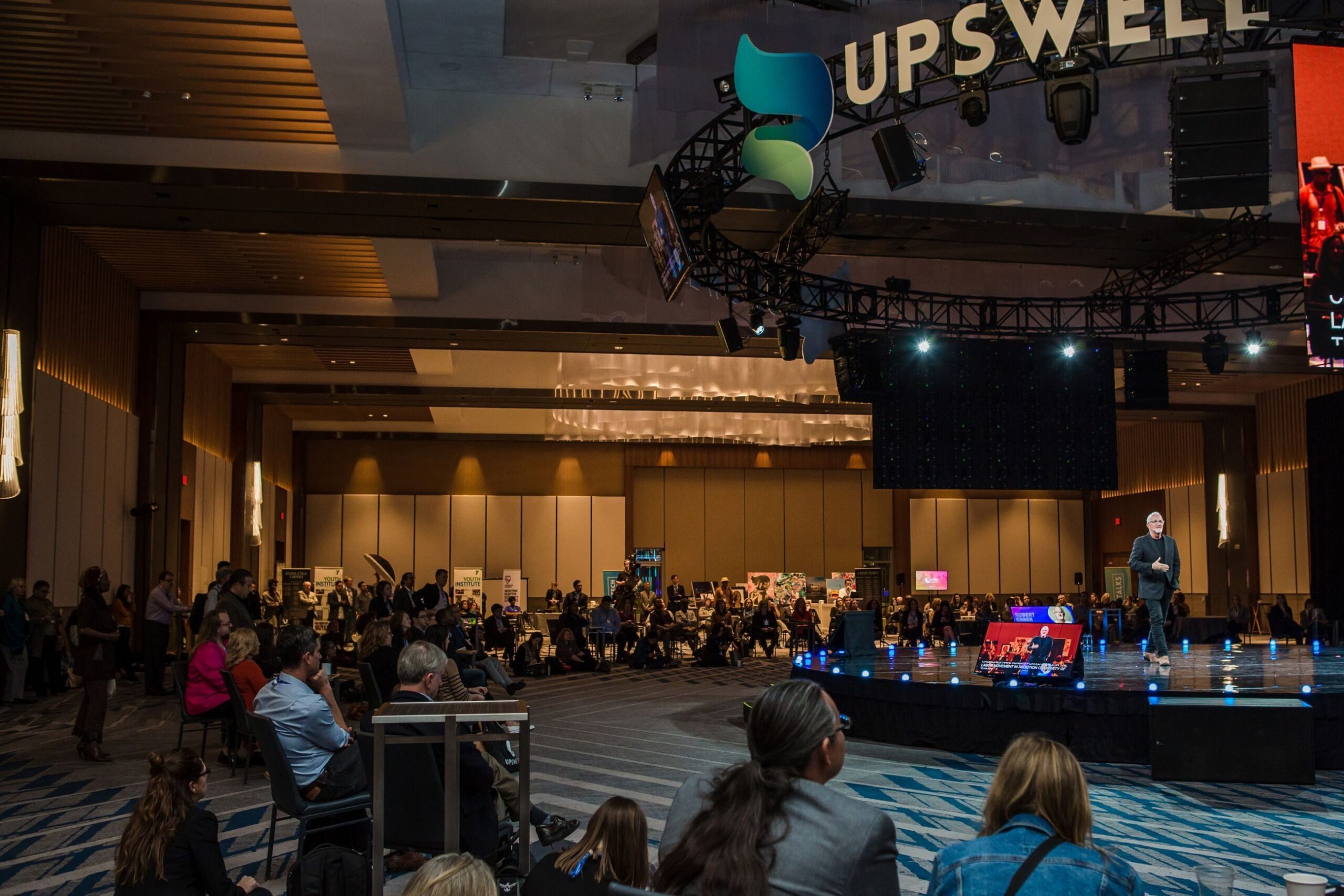
The name Upswell was chosen to evoke a different kind of energy — broad-based, bottom-up, and maybe a little unpredictable. Of course, creating an aspirational brand can be easier than creating an experience that lives up to the aspiration. So, starting with the first Upswell in Los Angeles in 2018, Cardinali and his team added five distinct features to the conference based on new-power principles.
1. Public Square
Traditional workshops are large and long, which limits the time and space available for presenting ideas. Grant makers typically get a large share of that real estate, other sessions are sold as a form of business development, and big, important members expect a platform as well if the conference is staged by a membership organization like Independent Sector. That leaves precious little space for authentic community voices with limited access to faraway conference planners.
So Upswell’s first innovation was the Public Square, a huge physical space that combined the plenary stage, performance areas, pop-up speaking venues, exhibit booths, demonstration areas, lounges, food service, and more. The goal was twofold: First, as a physical manifestation of the “public square” of civil society, the Upswell Public Square would encourage social collision, or the exchange of ideas between unlikely parties.
Second, with literally hundreds of presentation opportunities, the Public Square helped to solve the supply-and-demand conundrum of a traditional, workshop-heavy conference. To take just one example: 10-minute Spark Talks, modeled after the Speakers’ Corner in Hyde Park, offered a platform to almost anyone who wanted to present a mission, vision, problem, or solution. And because the Public Square would be “always on,” a Spark Talk presenter with a good pitch could be just as visible as a workshop presenter from a large, established organization.
2. Crowdsourcing
Faced with vastly expanded time and space, it would be impossible for centralized program planners to fill all the available program time at Upswell — something that turned out to be more of an opportunity than a challenge. From the very start, crowdsourcing was a crucial part of the Upswell formula, with the goal of reaching beyond the traditional Independent Sector network to bring in community voices.
In 2018, Upswell piloted a crowdsourced campaign for a limited set of workshops and most of the new Public Square. The campaign resulted in 96 submissions and 50 accepted presentations. However, year one showed room for improvement in reaching beyond Independent Sector’s existing audience: only 25 percent of crowdsource

submitters were new to the network.
The takeaway? Authentically engaging new power and new networks requires strategic planning and intentional outreach, areas where Upswell doubled down in 2019.
3. Community Organizers
Upswell aspired from the start to be “locally rooted and nationally relevant,” which meant getting attendees out of the hotel and into the local community. In the past, Independent Sector would have settled for tapping its own network of members to find community experiences, but new leadership realized that this approach might encourage a national, old-power lens on local issues.
So, while still being careful to highlight the work of the local Y, for instance, Upswell LA in 2018 also invested in hiring two lifelong community organizers to curate tours and dinners that were off the beaten track and very much off the national radar. Coming on the first day of Upswell, the community events provided a “lived experience” frame for all the workshops and other events that followed. Of all the programming at Upswell, these experiences earned some the best reviews from attendees.
4. Authentic Voices
The Upswell design team made two strategic choices about shifting Upswell’s audience to represent and include new power, while preserving space for old power to engage.
First, Upswell broadened its audience to “changemakers” — anyone committed to advancing the common good, regardless of title or affiliation. This included not only the traditional audience of nonprofit and foundation leadership but also individuals leading change in their communities with massive informal authority but no title or formal power; movements working to address timely issues and collaborate across sectors; social entrepreneurs, who push the boundaries of innovation and often work “between the lines” of business and nonprofit organizations; and corporate changemakers, who represent a blend of new and old power.
Second, to counteract systemic inequities that so often result in sector gatherings that are disproportionately white, the Upswell team set an explicit target of hosting 50 percent people of color, as both speakers and participants. First-year results were encouraging: people of color made up 47 percent of registrants, 51 percent of Public Square presenters, and 54 percent of workshop presenters.
5. Scholarships and Fellowships
At Upswell, funders were encouraged to select their own cohorts of scholarship recipients —dubbed Upswell Fellows — using whatever criteria made sense to them.
In decentralizing the selection process, the goal was a more diverse pool of scholarship recipients that reflected the priorities of various funders and the communities they worked in — as opposed to those of the conference organizer.
At the same time, this approach encouraged philanthropy to support change work and the building of social capital in ways they couldn’t imagine or control. No matter how “wired” the program team is at any foundation, it can never provide the kind of professional development that comes through social collision and collective meaning-making in a setting as diverse as Upswell.
Growing a New-Power Event
Upswell Chicago, scheduled for Nov. 13-15, is building on some of last year’s most successful experiments.
Instead of two community organizers, for instance, Chicago will feature three organizers with an even broader portfolio.
Crowdsourcing is another area of new-power growth. Much of the crowdsourcing effort in 2018 was focused on the Public Square, an untested concept with no real analog and no guarantee of success. In 2019, most content in the Public Square will once again be crowdsourced, but the model is now being extended to more workshops, where competition for space is usually intense. With approximately 84 hours of workshop time available across 62 workshops, roughly 60 percent has already been filled through a crowdsourcing campaign that saw 100 workshop submissions. And unlike 2018, when crowdsourced submissions were evaluated in house, in 2019 the entire community was invited to choose many of the “winners” with a public vote.
Other than expanding in those areas, Upswell Chicago will test several additional innovations based on new-power principles.
1. Platform
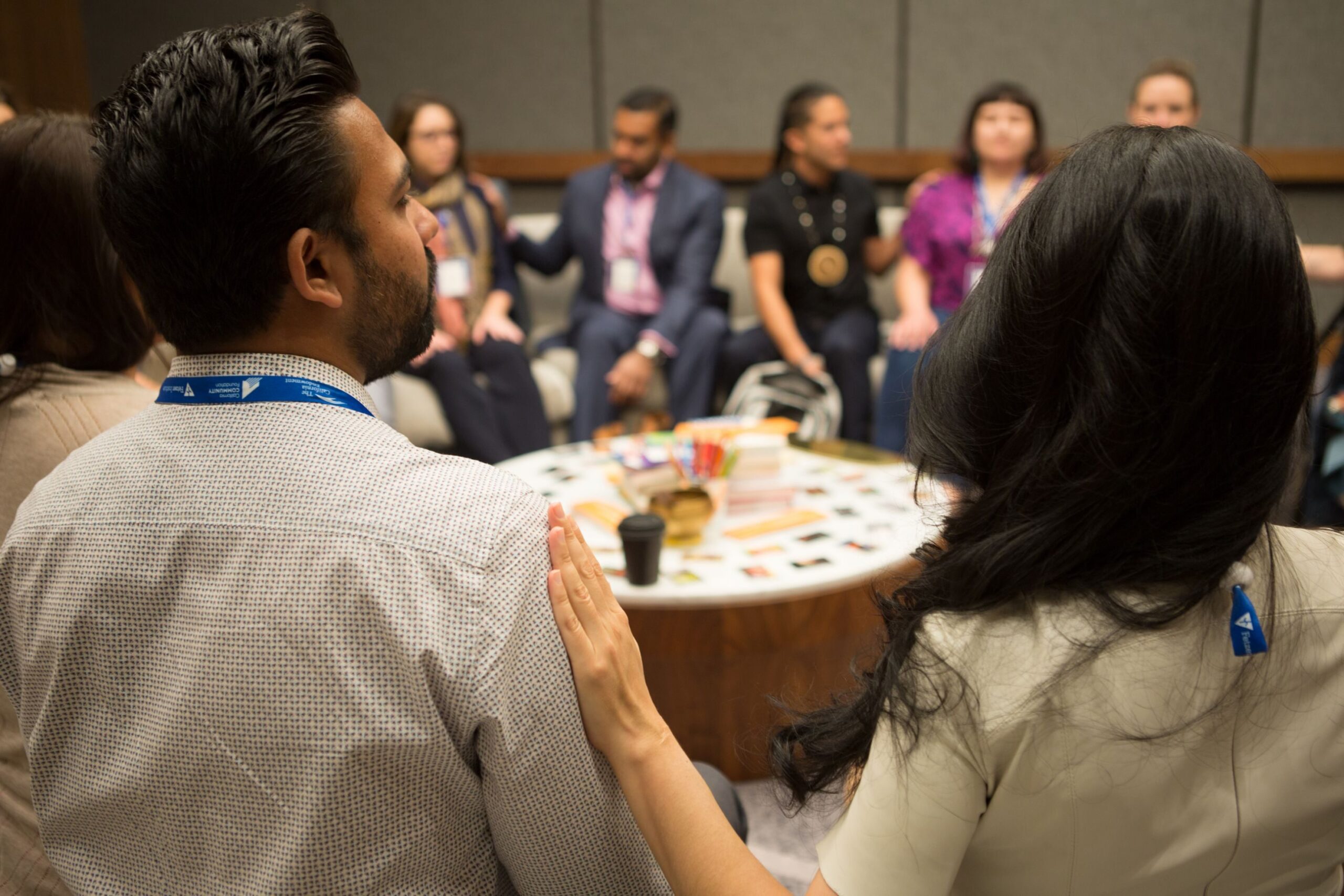
The term “platform” gets tossed around a lot, often with very different meanings. In the Upswell context, however, it means that partner organizations — from Equity in the Center to Weave: The Social Fabric Project — are invited to hold their own meetings in the Upswell space, and attendees are welcome to come and go between the partner convening and the main Upswell summit.
Upswell doesn’t attempt to edit or curate these convenings, but rather to intentionally market the opportunity to organizations across the spectrum of ideology, geography, and mission area in order to create a “big tent” rather than an echo chamber. For Platform partners, the invitation is to “go deep” in their specific area, then leverage the broader convening to share and test ideas with changemakers from around the country — opening up feedback loops and creative collaborations in ways that would be impossible on a smaller scale.
2. Accelerator
From the very start, one of the biggest ambitions for Upswell was a “leave behind” for each host city — some sort of permanent contribution that would support and accelerate civil society’s powerful contributions in the region. This idea was central to Chicago planning, and one of the first organizing tasks was to invite a broad swath of community leaders to serve in a group known as the Upswell Accelerator. Far more than a traditional host committee or program committee, the Accelerator was charged specifically with answering the question: If the leaders of American civil society descend on Chicago for three days, what is the greatest lasting benefit they can contribute to the area?
This was no easy question, and the Accelerator wrestled with it over a number of months under the leadership of a Chicago community organizer, not a staffer from Washington. What’s emerging is a citywide equity framework that’s never been attempted before. After months of additional listening and fact-finding, the Accelerator hopes to present a blueprint this November at Upswell — showing changemakers from across the country what is possible when a city comes together on an important issue.
The work will go on beyond November, of course, and Upswell will continue to highlight and support the effort in the coming years.
3. Equity Pricing
It costs money to stage an event like Upswell, and Independent Sector is wary of sucking up too many philanthropic dollars that are needed in the host communities. Registration fees are one of the obvious ways to stay out of the red, but there are both fiscal and philosophical issues to consider in setting those fees.
With the goal of democratizing access and bringing new voices into the conversation, the Upswell team wrestled with a pricing structure that could optimize income from bigger, better resourced organizations without discouraging smaller, community-based groups. New power required new pricing, and the result was an equity pricing model where Core registration represents the “true cost” of the event, but two lower price points are also available:
- Subsidized, for organizations with budgets under $1 million,
- and Independent, for community leaders or volunteers without any formal organizational affiliation.
Thus far, about 20 percent of registrations are coming in at the lower price levels, enough to indicate solid demand from new, diverse attendees without threatening the financial viability of the overall event.
Fostering a New-Power Community
Today, most people experience Upswell as a three-day summit, but Upswell aspires to be something bigger: an enduring, self-identified community of changemakers that mixes both old and new power, national leaders and community activists, grant makers and grant seekers. As the next step in this evolution, Walmart Foundation has funded a multiyear fellowship program that will start in Chicago and continue in Pittsburgh (the site of Upswell 2020), creating a cohort of community-based leaders who have an ever-broadening base of social capital.
As a year-round community, Upswell can offer even more opportunities for new-power values, such as self-organizing, crowdsourcing, and opt-in decision-making. Broad participation is the goal, but Cardinali hopes that enduring relationships formed at Upswell might test the preference for “short-term, conditional affiliation” that authors Jeremy Heimans and Henry Timms have observed in other new-power movements.
Can new-power values coexist with an older sense of community? That’s what Upswell aims to find out.