
Unpacking Race, Equity, and the Arts
September 27, 2018 | Read Time: 6 minutes
You never know what can happen over a bowl of ramen.
Last November, when I met my friend and colleague Rebecca Burrell for lunch at a noodle shop in downtown Portland, Ore., I had no idea it would lead to a local movement to challenge racial and ethnic inequities in our arts sector. Rebecca is one of the co-founders of Portland Emerging Arts Leaders (PEAL), a volunteer-driven organization supporting enthusiastic and forward-thinking arts professionals. I met her through my participation in PEAL’s professional-development workshops and core leadership committee, which complemented my full-time work in fundraising at the Portland Art Museum.
As we slurped warm noodles on a rainy day, our conversation turned to the glaring lack of racial and ethnic diversity in the arts in Portland. Portland has been described as the least diverse city in America, with 72 percent of its population identified as white.
The arts field has not escaped this legacy. The majority of people who work in and patronize the arts are white. Consequently, arts organizations have not been designed to reflect the experiences, needs, values, language, or history of people of color. This is by no means breaking news. Currently, conversations around equity — at its core, a question of who receives access to resources and why — are in full force within the arts sector in Portland, as they are across the country.
Personally, I have been lucky. I owe much of my arts career to my participation in the Getty Multicultural Internship Program, a Los Angeles initiative that provides full-time paid internships for college students from cultural backgrounds that have traditionally been underrepresented in the arts. We have nothing similar in Portland. Like me, Rebecca had been part of conversations surrounding equity for some time, so over that fateful lunch, a project was born: PEAL would specifically address racial and ethnic equity for the first time.
As you might imagine, that’s a huge and complex task — far more so than I realized at the time.
In evenings and on weekends, in coffee shops and in our living rooms, Rebecca and I got to work. We organized a group of seven enthusiastic emerging leaders to kick-start grassroots programming related to equity. That group became PEAL’s first Equity Committee. The committee seeks to raise awareness and dialogue about racial and ethnic equity in the arts and to drive tangible change based on recommendations from the community.
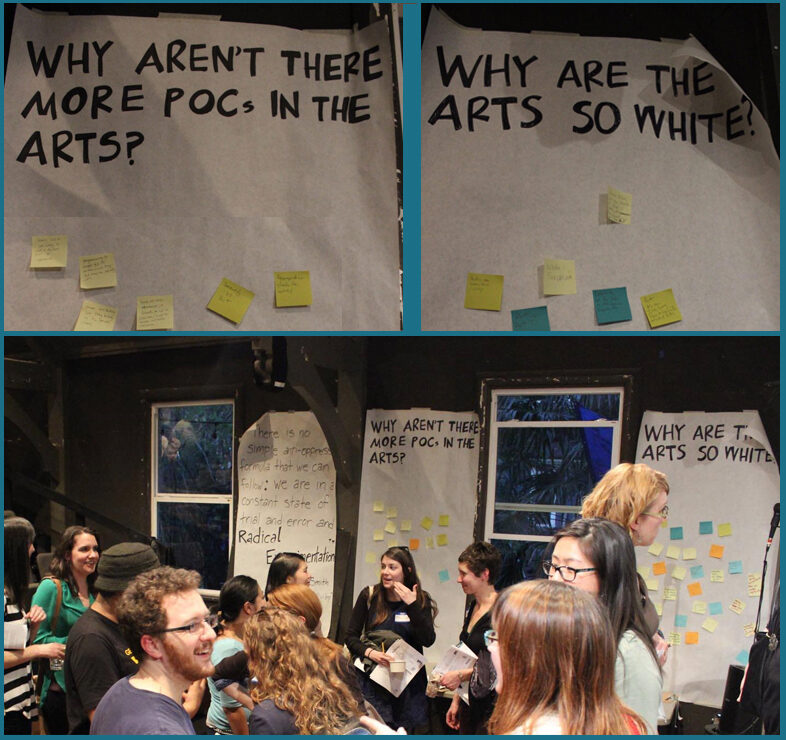
The committee’s pilot event was a forum in March 2016 designed as a “temperature check” on how arts professionals in Portland were feeling about issues of race, power, and representation within the sector. We called it “Why Are the Arts So White? A Think Tank on Racial Equity in the Arts.”
RSVPs soared beyond our expectations, with over 50 members of the arts community attending the event. We shared ideas, personal experiences, and potential pathways for changing the composition of the arts sector. Participants identified a need for resources to help local arts organizations start their own equity work, and a desire to move from conversation to measurable action. Afterward, we released a Pulse Report documenting our findings. I’ve presented this work in webinars and talked about it at conferences in the hope that others in Portland — and beyond — might find it helpful in crafting a more just and equitable world.
The Challenge of Addressing Equity
The process, from starting the committee to organizing the Think Tank, was truly a whirlwind. I have experience in grassroots community work, but this was different from anything I had done before, for a number of reasons.
First, addressing what we call “white supremacy,” power, and privilege is messy. For the Think Tank, we did not have an established model on which to build. We had no idea how the arts community would respond, or who would show up for a conversation that is inherently sensitive and potentially explosive. We were making space for very uncomfortable questions to surface.
Second, we are working outside of institutionalized systems. The Think Tank was free and open to anyone who wanted to attend. It happened solely through a combination of sweat equity and in-kind donations (thanks largely to Portland Playhouse and a $50 contribution from PEAL for snacks). Most critically, the Equity Committee is not beholden to the values of any one arts agency, meaning that we can ask questions that most organizations would not dare touch.
Third, the process itself is as important as the product, if not more so. In its Think Tank planning, the Equity Committee spent a large part of the time considering the processes and assumptions underlying our work. From venue to outreach, we wanted to practice the equity that we were espousing. That meant hosting the event in a space that had a history of supporting artists of color. It meant sending personal invitations to people of color to ensure that voices of color were strongly represented. It meant creating numerous ways for individuals to process and share feedback (written, verbal, and anonymous). It took hours of deliberation in person and over email on the values by which we were crafting this event and working with each other.
We were sparking a grassroots conversation on equity with the Portland community at large, but at the same time, we were deep in the throes of developing our own more equitable practices and processes as a planning team.
Looking Forward
The Equity Committee is still hard at work. Our next event is a story-sharing activity with arts professionals of color in Portland, called “Real Talk: People of Color Speak Out on Working in Arts Organizations.” We are collecting personal accounts from arts administrators of color about their experiences — from the application, interviewing, and hiring process to being on staff, navigating workplace culture, and more. We’ll use these responses to build an archive of individuals’ experiences in the sector at pealrealtalk.tumblr.com, which we envision as a launch pad to explore practices for making arts organizations truly supportive for individuals of color. (If you are an arts administrator of color, we invite you to share your stories with us!)
We are remaining intentional and adjusting course based on what we learn along the way. In the long term, we hope to use the feedback that we gather to generate tool kits and strategies for arts leaders to implement citywide, with the aim of increasing the number of individuals of color in arts leadership and holding organizations accountable to racially equitable policies and practices.
A familiar saying perfectly sums up my current attitude toward leadership and change-making: “You can’t keep doing the same things and expect different results.”
Leaders of the present and the future, I encourage you to grab a bowl of ramen and ask yourself: Who are you serving in your work? Whose values take precedence in your daily life and why? And, specifically, how many people of color in power do you know? They are not easy questions, but an honest look at the answers may surprise you.
To learn more, visit LeaderStories.org