Fusion of Old and New Supporters Drives Record $60 Million Campaign for Group Seeking Criminal-Justice Reform

By Drew Lindsay
Senior Editor, Special Projects
April 12, 2018 | Read Time: 12 minutes
At the Vera Institute of Justice charity gala this month, where tables at a Manhattan restaurant will go for as much as $100,000, the old and the new in criminal-justice work will stand together.
On behalf of Vera, 82-year-old Vernon Jordan, one of the lions of the civil-rights movement, will present an award to the digital giant Google. Vera has been fighting for a fair criminal-justice system since its founding in 1961. Google, through its philanthropic arm, Google.org, has been at it for less than three years.
Yet the two are now partners, in large part because Vera has aggressively repositioned itself — and reimagined itself — to take advantage of a new philanthropic climate as well as new players like Google. It’s also fighting Trump administration criminal-justice policies that it sees as reversing progress made under President Obama. Just this week, the U.S. Department of Justice halted a Vera-run program that offers legal counseling to immigrants facing deportation.
Once almost wholly reliant on relatively small project grants from old-line foundations, the venerable organization is now winning “big bet” grants from an array of donors that includes Google.org, which last year made a $4 million commitment to Vera.
Altogether, Vera has raised $60 million in a campaign that’s not two years old — more than six times the total of any previous campaign effort. The organization is capitalizing on the growing philanthropic interest in both criminal justice and large unrestricted gifts. The Ford Foundation, which typically backs Vera with six-figure grants, gave the organization $8 million, the bulk of it earmarked as general support. The Ballmer Group, a limited-liability corporation founded by former Microsoft CEO Steve Ballmer and his wife, Connie, donated $20 million in unrestricted funds.
“This is Vera’s moment,” says Darren Walker, president of the Ford Foundation. Conservatives, liberals, and moderates have come to a “collective diagnosis” that mass incarceration must end, he says. At the same time, a new generation of tech-driven philanthropies is mobilizing behind the issue, joining longstanding Vera supporters such as Ford and the Open Society Foundations, which gave $10 million to the campaign.
Rip Van Winkle Moment
Vera President Nicholas Turner represents both the organization’s old form and its new incarnation. He first came to Vera in 1995 as an intern while a Yale law-school student; he returned in 1998 and worked for nine years. Among other things, he launched Vera’s center on sentencing and corrections at the state level.
In 2007, Turner moved to the Rockefeller Foundation, where Darren Walker was a top executive. With Walker as his supervisor, Turner served as a managing director and worked on issues related to transportation equity, economic security, and redevelopment in New Orleans following Hurricane Katrina.
Criminal justice was not part of Turner’s Rockefeller brief. And when he became a candidate for Vera’s presidency in 2013, he was struck by the radical change in the criminal-justice movement during his years away.
“It was like being Rip Van Winkle, in a way, going to sleep and waking up to a very different world,” he says. Bipartisan opposition to mass incarceration had emerged. The media and public were suddenly focused on criminal justice. And an expanded roster of donors was lining up to invest big dollars.
In his interviews with the Vera board, Turner says he argued that the organization had to remake itself to seize this historic opportunity to bring about change. It had to be more ambitious and focus less on small-bore projects and more on work that reached multiple states, he said. At the same time, Vera had to retool its operation and build a new business model focused on the donors — both individuals and foundations, old and new — invested in its half-century battle.
For Vera, the means to that end was the campaign. It began in 2016 and aimed to raise $50 million. Half the money would go to work designed to have immediate impact. The remainder would, in Turner’s words, help the organization “build a bridge” to its future, with $20 million earmarked for its reserve funds — three times what it had on hand in reserves at the campaign’s start. Such a cash cushion would ensure the organization’s sustainability and give it room to take risks, Turner says.
Vera also asked donors for $5 million to modernize and boost its operations — in communications, development, information technology, and other nuts-and-bolts departments. The goal: begin an organizational makeover to give it the means to fulfill and sustain its broader ambitions.
‘Shoot for the Stars’
In the campaign, Vera turned to its longtime foundation supporters as the likely base of its campaign-giving pyramid. “It really wasn’t an easy sell,” Turner remembers. “They definitely believed in the organization, but they needed to be persuaded that the organization was going to shoot for the stars.”
Ford saw Vera as a natural fit for its Build program, which began in 2015, and pledged $1 billion in general support to nonprofits over five years. Vera, Walker says, is a critical player in criminal-justice issues.
“The question for us was: If Vera didn’t exist, would we have to invent it?” he says. “The answer is yes.”
Over time, Vera’s blueprint for change impressed the foundation. It is ambitious and features clear measures of its impact, according to Walker. “And it is sustainable. Unfortunately, nonprofit strategic plans are not realistic sometimes. They come up with a plan that they can’t actually execute because the gap between where they are and where they want to be is so wide. In Nick’s case, he has articulated a compelling vision that has mobilized all of us.”
Vera also approached the Tow Foundation, which has supported its work for nearly 20 years. For the campaign, Tow pledged $1 million over four years — a substantial commitment for a family foundation whose annual grant making typically totals about $15 million.
“Nobody had ever asked us for $1 million before,” says Emily Tow Jackson, the foundation’s president and daughter of Leonard and Claire Tow, founders of Century Communications Corporation, a cable-television and cellular company. Jackson applauded Turner’s courage for the big request — and Vera’s ambition to make the most of the seismic changes in the criminal-justice field. Tow, too, decided to seize the moment.
“The transformation that has gone on at Vera in the last few years brought us into the fold in a much more significant way,” Jackson says. “They’re willing to use their credibility that they’ve built over all their history to say: ‘We’re going to be bold. We’re going into new territory.’ ”
‘Trumpian Moment’
Turner’s courtship of Google.org took time. He approached Justin Steele, who directs the racial-justice portfolio of the tech giant’s grant-making arm, not long after it announced in 2015 that it would invest in criminal-justice efforts. Turner pitched Vera’s plan to end solitary confinement in five years. Steele didn’t bite.
“It was obviously a compelling issue,” Steele says, “and one that deserved funding. But we couldn’t quite find the ‘googly” grant within that space that was leveraging technology and innovation.”
Google.org likes to back established organizations, Steele says, but it also wants to pursue groundbreaking work. “You want folks who have a proven, outcome-based, evidence-based approach to their work. At the same time, tech funders are also drawn to things that are really innovative and disruptive.”
In early 2017, Turner and Steele had lunch near Google’s San Francisco offices. Turner talked up not a funding proposal but surprising new Vera research. Analyzing 45 years of Department of Justice data, it had found a counterintuitive trend: Incarceration rates were climbing in rural America but declining in big metropolitan areas. Mass incarceration, long considered a critical issue for blacks and Hispanics in cities, was just as important for whites in flyover country.
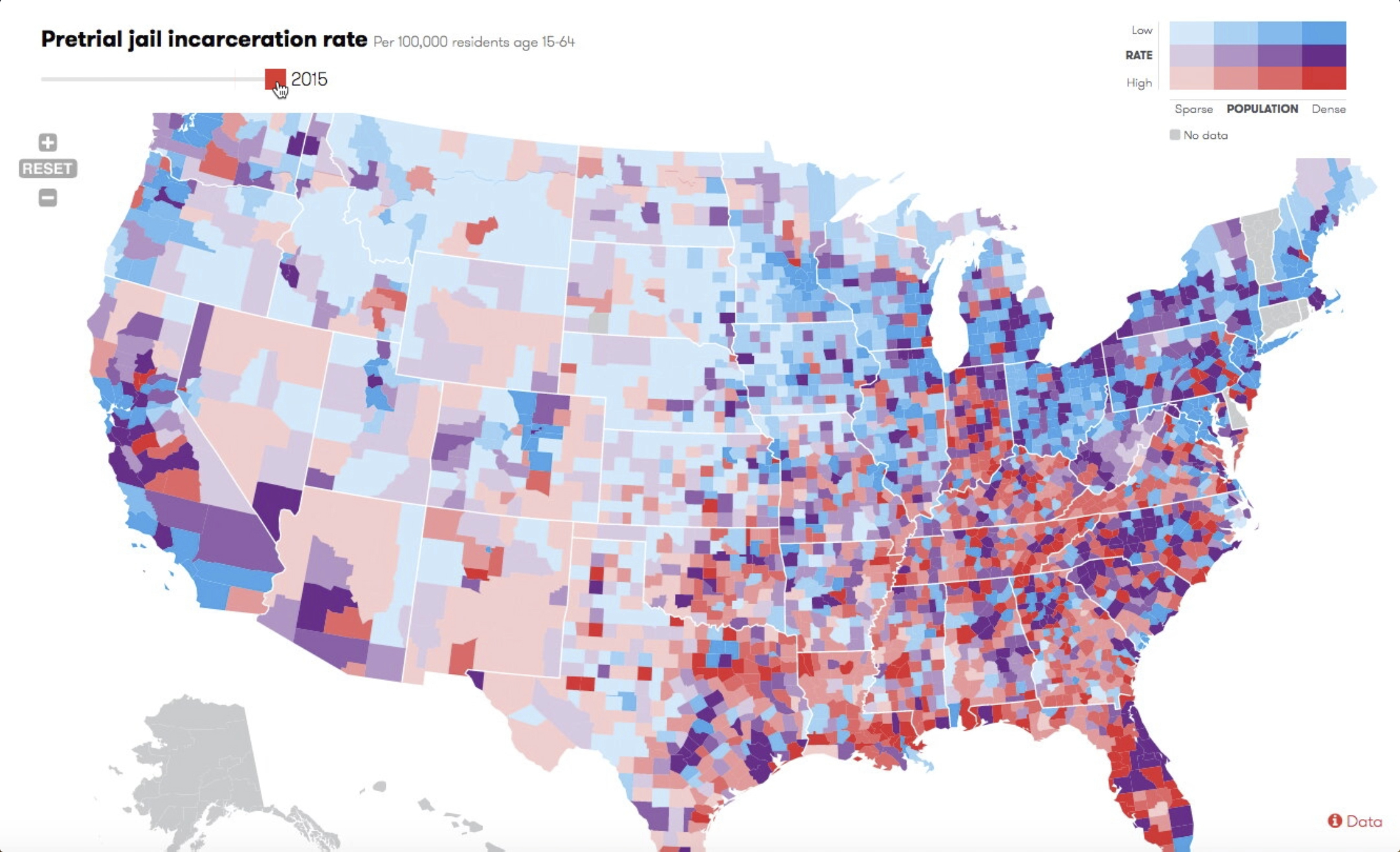
These findings made for a “Trumpian moment,” given the presidential election’s rural-urban split, Turner says. The data almost mirrored ballot-box results; rates of people sent to jail in counties that voted for Donald Trump were 53 percent higher than in Clinton counties.
Steele was intrigued. Through first-of-its-kind research, Vera had discovered a new perspective on an old problem. The data now had to be analyzed further and made available for others to study — work to which Google engineers could contribute. And the findings hinted at something bigger in the election’s aftermath: Criminal justice could be common ground for a seemingly splintered country.
Google initially pledged $2 million for work spun off from this data, then doubled the figure. Vera now is the second-largest grantee in Google.org’s racial-justice portfolio, which includes Bryan Stevenson’s Equal Justice Initiative.
Surprise Grant
The Ballmer Group, which is focused on improving economic mobility, is perhaps best-known for it support of education and children’s efforts. Last year, the husband-and-wife team pledged more than $100 million collectively to StriveTogether, a national nonprofit that seeks to improve education for low-income children; Building Educated Leaders for Life, or BELL; and College Possible, which helps low-income students enroll and succeed in college. These gifts were all unrestricted.
Jeff Edmondson, the Ballmer Group’s managing director, says the organization considers criminal-justice overhaul a key to improving economic mobility. It generally backs organizations that, like Vera, are working with the government because it believes such partnerships have the best chance to produce enduring change. It also saw Vera as a “best in the field” organization that had clearly defined measures for its impact.
Ultimately, the Ballmer team concluded it could best help Vera by providing unrestricted support. Says Edmonson: “Far too often in the nonprofit sector, there are not general operating-support grants to help organizations that meet these criteria get to a level of scale that we would hope to see.”
Turner says he was shocked when Ballmer Group officials proposed the size of the gift. “I nearly fell out of my seat. You don’t have a lot of conversations with donors who say they want to make a significant multiyear, unrestricted grant.”
New Players
Several other tech-backed philanthropies are supporting Vera. The Open Philanthropy Project, the charitable-giving vehicle of Cari Tuna and Facebook co-founder Dustin Moskovitz, didn’t contribute to the campaign but is backing specific projects.
Art for Justice, the nonprofit launched last year by philanthropist and art collector Agnes Gund, contributed $450,000 to Vera and is “gearing up to do more,” says Helena Huang, the organization’s project director.
Huang says Art for Justice distributed $22 million in its first round of grants and is targeting big commitments for “anchor organizations.” Vera, she says, “is one of the rare groups that has the credibility among systems reformers — particularly the prosecutors — as well as with grass-roots advocacy groups. There are few groups positioned to bridge the world of research and advocacy in a way that is so critical, particularly at this moment of opportunity.”
Thanks to campaign funds, Vera has done large-scale work that previously might have focused on a single state or city. For instance, it established a “race to the top” competition in which it offered cities funding and support in exchange for a concrete commitment to help immigrants facing deportation. Twelve cities won, with Vera and the municipalities paying for legal-defense costs.
On the Google.org project, the company’s engineers will soon team up with Vera researchers to dig further into the rural-urban incarceration data and create an interactive database that the public and scholars can access. It will also help Vera conduct qualitative research in incarceration “hot spots.” The goal: find the causes of increasing incarceration rates in the heartland.
Vera’s new allies in its work include a powerful group of Oklahoma City-area businesses led by Clay Bennett, the owner of the city’s professional basketball franchise. Bennett and his group are working with Vera to study the dynamics of overcrowding at the county jail and propose solutions, including limiting pretrial imprisonment and jail time for minor offenses.
Within its offices, Vera has been working to adjust its culture and staffing to think in terms of large-scale efforts. Designing work to end solitary confinement in five years, Turner says, “requires flexing a totally different set of muscles for people used to getting a $250,000 grant to write a report.”
Vera has revamped its communications efforts, with good results. Its audience on Twitter, Facebook, and other social-media platforms increased 178 percent in a year, and its web traffic in 2017 jumped 50 percent over the previous year.
Although the campaign has topped its initial $50 million goal, Vera is extending the fundraising effort to further build what Turner calls a “retail operation” that can attract a range of donors. With additional money, it hopes to spread the success of any particular project nationwide.
That’s important, Turner says, because the criminal-justice system is incredibly diffuse, with power wielded by politicians, judges, prosecutors, corrections agencies, and others. “It’s this Rube Goldberg machine that produces all sorts of horrible things, but to take it down is really tough.”
Campaign Contributions to the Vera Institute
Ballmer Group ($20 million; unrestricted)
Open Society Foundations ($10 million; reserves)
Ford Foundation ($8 million; mostly unrestricted)
Google.org ($4 million; incarceration analysis)
MacArthur Foundation ($3 million; local justice systems)
Andrew W. Mellon Foundation ($1.5 million; postsecondary education)
Charina Endowment Fund ($1 million; endowment)
Tow Foundation ($1 million; unrestricted)
Source: Vera Institute of Justice
Corrections: The word “million” was inadvertently left out of the amount given by Steve and Connie Ballmer the Ballmer Group. Also, the piece referred to the Ford Foundation’s Build program as its Bridge program; the Tow Foundation contribution was not a matching gift; Agnes Gund gave $450,000, not $300,000; and the legal costs for the “race to the top” effort to help illegal immigrants will be paid by Vera and the 12 winning cities but not through matching grants.