
Q&A on the Chronicle’s Report on Diversity Work and Staffing
September 18, 2020 | Read Time: 8 minutes
The Chronicle of Philanthropy has undertaken multiple efforts in the past year to ensure our work and operations reflect the diversity of the nation. To do that, we have undertaken an intensive yearlong coaching effort for our newsroom and have just released an independent analysis to show the people we include in our articles and who writes our opinion pieces.
Our parent organization, the Chronicle of Higher Education, is also underway on a broader effort aimed at ensuring that our staffing, recruiting, and culture are welcoming and supportive to people of different backgrounds.
Following are details about the process used to conduct the Chronicle of Philanthropy study and its rationale.
We felt it was important at the same time to tell you a bit more about our own staff and about our work to ensure both our journalism and our newsroom operate in ways that advance our commitment to diversity, equity, and inclusion.
Why did the Chronicle commission a study of the people it includes in its articles and whose opinion pieces it publishes?
As a news and information organization that covers the nonprofit world, we depend on an array of people to help us better understand the topics, issues, and themes that are essential to our readers. While we have long recognized that a broad reach ensures that we produce stronger articles, we did not have any quantitative data to help us understand how well we were doing in reaching out to people who are too often left out of conversations about the nonprofit world. Nor did we have information about the people whose opinion articles we publish so that we could understand better how well what we published reflected a diversity of views.
Gathering this information has allowed us to create a baseline so our reporters and editors can do their best to ensure they are seeking out a wide range of people with expertise, advice, and experiences to enrich the coverage we provide to our readers.
It is worth noting that many articles involve a lot of research with people who do not end up in the piece, so looking at those who do reflects a conservative way to measure whom we’re interviewing.
How did the Chronicle conduct its research?
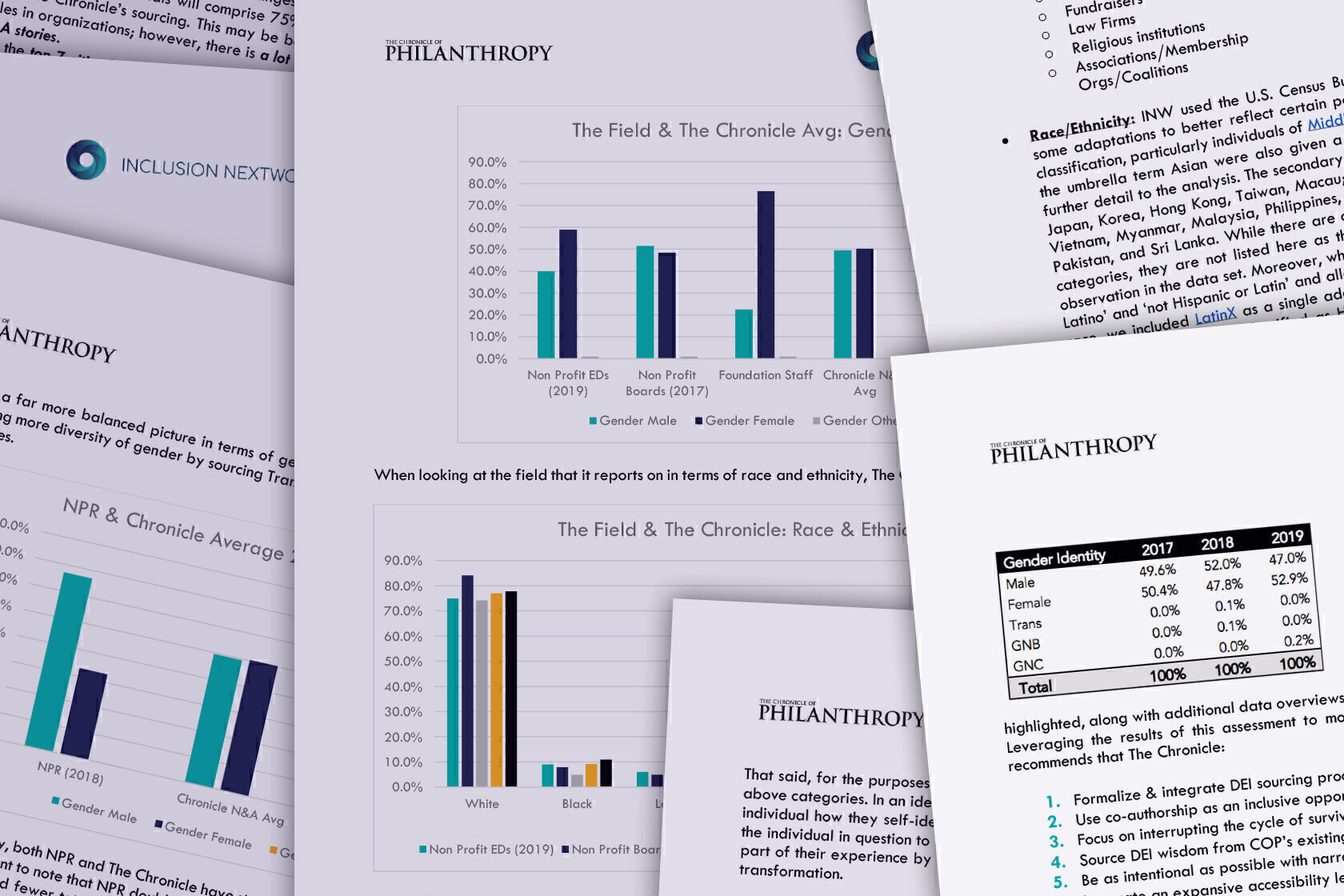
After a national search, we hired Inclusion NextWork to review more than 1,200 news, feature, advice, and analysis articles, along with more than 300 opinion pieces, published in 2017, 2018, and 2019.
We also hired a third-party natural-language processor, Synaptiq, to extract proper names of sources; it is possible that some names were missed due to biases in the natural-language processing algorithm.
Altogether, the assessment was based on 2,500 individuals who were included in our articles and 300 authors who wrote opinion pieces.
How did you decide what to study?
We focused on gender, generation, race, ethnicity, and geography as meaningful markers that were readily available. But we know that many other important areas of identity were not included in this project. Chief among them are sexual orientation, disability status, citizenship, and veteran status. We hope to delve into some of those areas in future assessments, and we are keeping an eye on those criteria in our reporting and editing.
How did you determine the identity of the people studied?
Inclusion NextWork used third-party sources, such as biographical information available from personal and individual websites, from LinkedIn, and through additional research. Chronicle reporters and editors also helped provide details about people they had interviewed and reached out to opinion authors and news sources when we had questions about their race, gender, generation, or geography.
How does your analysis compare with the representation of people in the nonprofit and foundation world?
It’s important to keep in mind that the Chronicle is aimed mostly at people who hold leadership roles at nonprofits and foundations and people focused on raising private donations; we know they are more predominantly white than people in other parts of the nonprofit world.
Among our key findings:
- From 2017 to 2019, representation of people who are Black, Hispanic, or multiracial and others who are not white increased from 20 percent to 30 percent of those included in our stories or who wrote opinion articles. As one point of comparison, 25 percent of nonprofit executive directors are people of color.
- In those same years, roughly 50 percent of the people mentioned in our news articles were women, even though they make up 60 percent of executive directors over all. However, in our opinion articles, 60 percent of authors last year were female, an increase from 40 percent in 2017.
We also learned that we fell short on including millennials, especially notable because by 2025 they will be the largest segment of the nation’s work force. And we learned that we need to do more to ensure that we talk to people who are based in places other than the East and West coasts.
How does the composition of your staff compare when measured in the same way you looked at your sources?
We have 11 reporters and editors. Of those, three are millennials, six are members of Generation X, and two are boomers. Four are men and seven are women. All 11 are white.
We also share a team of 12 visual artists and data and interactive specialists with the newsroom of the Chronicle of Higher Education, our sister publication. Four of them are millennials, three are members of Generation X, and five are boomers. Six are male and six are female. Eleven are white; one is Latina.
We have no people of other races or ethnicities on those staffs, though we do in other parts of the company.
Our staff includes people raised and educated across the county, and many have worked for other organizations throughout the United States. Most are based in the Washington, D.C., area, where are headquarters is located.
Who financed the research?
The William and Flora Hewlett Foundation provided a 15-month, $107,993 grant we could use to enhance our diversity, equity, and inclusion work. We chose to use that grant to cover the assessment of our sources as well as to provide individual coaching for our newsroom staff. We conducted a national search to hire the coaching consultant Kathleen LaTosch, who has a background working with news organizations and nonprofits. She is leading a yearlong effort to help the Chronicle’s journalists develop their ability to connect with and relate to people with backgrounds different from their own, including strategies to identify and interrupt bias.
The rest of the grant underwrote our reporting for two cover stories: our March piece on how nonprofits can better raise money from donors of color and our July article on how the nonprofit world is responding to the national reckoning on race touched off by the killing of George Floyd.
How do the Chronicle findings compare with other media organizations?
We found that very few organizations have released analyses of their sourcing, although many individual reporters at news organizations informally keep track of data similar to ours and sometimes release them on social media and elsewhere.
In the report, Inclusion NextWork noted an analysis National Public Radio conducted that has guided its work, along with an analysis of how the diversity of voices heard on its broadcasts have changed since the tracking began. NPR’s staff members found this kind of assessment so important that they recently asked the organization to do more to ensure every part of the NPR newsroom is doing this type of analysis.
Inclusion NextWork noted that NPR’s data collection was somewhat different from the Chronicle’s but that over all the Chronicle did better in terms of including women. It noted that both organizations had an overrepresentation of white men’s voices.
We hope our release of this report will encourage other news organizations to conduct similar assessments, make them public, and monitor their performance over time.
What’s next?
Chronicle journalists have received snapshots of the demographic profile of the people they have mentioned in their stories. They are working to explore how to expand the range of people they interview. We’re making efforts to regularly reach out to people who can suggest more experts, and we invite you to contribute your ideas. We expect to regularly repeat this assessment of the people we include in our articles and who write opinion pieces to see what has changed, and we will continue to disclose our results to the public.
For our newsroom staff training, we are using the Intercultural Development Inventory, a highly regarded approach to training and testing, which measures the changes in the skills of our editorial staff members — and helps our coach better understand where we have gaps.
The Chronicle of Higher Education is also working to improve its recruiting and retention practices to ensure we do more to diversify our staffs. We are seeking ways to ensure that freelancers and other contractors better reflect the demographics of the nonprofit world. We are continuously making efforts to ensure our staff members have opportunities to advance, are treated with respect, and feel a sense of belonging.
The work we did with Inclusive NextWork was led by Cody Switzer and Maria Di Mento.
Do you have questions or comments about our work? Send us an email to feedback@philanthropy.com.




