Chattanooga Nonprofit Tries to Save Marriages to Save the City
A new class divide is emerging as marriage fades in Middle America. But Tennessee’s First Things First believes it has an answer.

By Drew Lindsay
Senior Editor, Special Projects
August 3, 2015 | Read Time: 11 minutes
Chattanooga, Tenn. – The courthouse is a century-old grande dame of gray marble and neoclassical lines that speak to her authority over this city in the Appalachian foothills. Each day, from within the office of the county clerk, she renews driver’s licenses, issues business permits, and grants the right to hunt and fish. And each year, she unites some 2,000 couples under Tennessee law with a license to marry.
Yet in the surrounding blocks, scattered in various office buildings, lawyers toil to sever the marriage bond and return couples to the courthouse as petitioners for divorce. It is a cycle repeated daily across America: What one legal entity creates another destroys.
In Chattanooga, however, a third force is at work. The nonprofit First Things First opened its doors nearly 20 years ago with a pledge to strengthen families and reduce the rates of divorce and out-of-wedlock pregnancies. Through 600 classes yearly, the group teaches the personal skills it believes make for healthy relationships — key among them, how to communicate and resolve conflict. The 20,000 people who attended the classes in 2014 included not just the married and bound for matrimony but also unwed expectant parents, new fathers, high schoolers, singles, and more. There were lawyers and gangbangers, housewives and prostitutes. The goal: Equip people from all walks of life with relationship skills that, when put to use in a marriage, will strengthen families.
First Things First contends that marriage matters — to children, the economy, and Chattanooga. The message has attracted conservative donors that include the Maclellan Foundation, a local Christian-based family grant maker. Jeb Bush, Marco Rubio, and other Republicans in the 2016 presidential race have made a similar argument.
In years past, liberals have pounced on such rhetoric as an attack on gays and women rooted in a 1950s Ozzie and Harriet worldview. Yet with the increasing acceptance of gay marriage, voices from across the political spectrum are sounding like First Things First. Researchers have coalesced around the idea that marriage represents a growing class divide: While it thrives among the college-educated, the remaining two-thirds of America are seeing out-of-wedlock births and single-parent homes become the norm. In one study of the oldest millennials, 74 percent of mothers without a college degree had a child outside marriage by their late 20s.
“In our polarized public debate, an unexpected consensus has begun to crystallize across ideological lines that the collapse of the working-class family is a central contributor” to America’s growing inequality, the Harvard scholar Robert Putnam writes in his recent book, Our Kids.
Policy thinkers from both the left and the right are talking about marriage as a “wealth-producing institution” and are working together to close the “marriage gap.” More than 100 recently came together as the Marriage Opportunity Council. They issued a manifesto declaring: “For the first time in decades, Americans have an opportunity to think about marriage in a way that brings us together rather than drives us apart.”
Filling the Toolbox
The smell of fried chicken fills the First Things First meeting room one recent evening as nine couples gather for a premarital education class that kicks off with dinner. Most of the men and women are in their 20s, while a few are closing in on middle age. All are headed for what they hope will be marital bliss.
Cheryl Robinson, a professor of family studies at the University of Tennessee at Chattanooga, leads the class. After dinner and introductions, she adds a glum note to the pre-wedding giddiness. “Sometime in the next 50 years or so,” she says, “you’re going to look at your spouse and say, ‘What was I thinking when I married you?’ ”
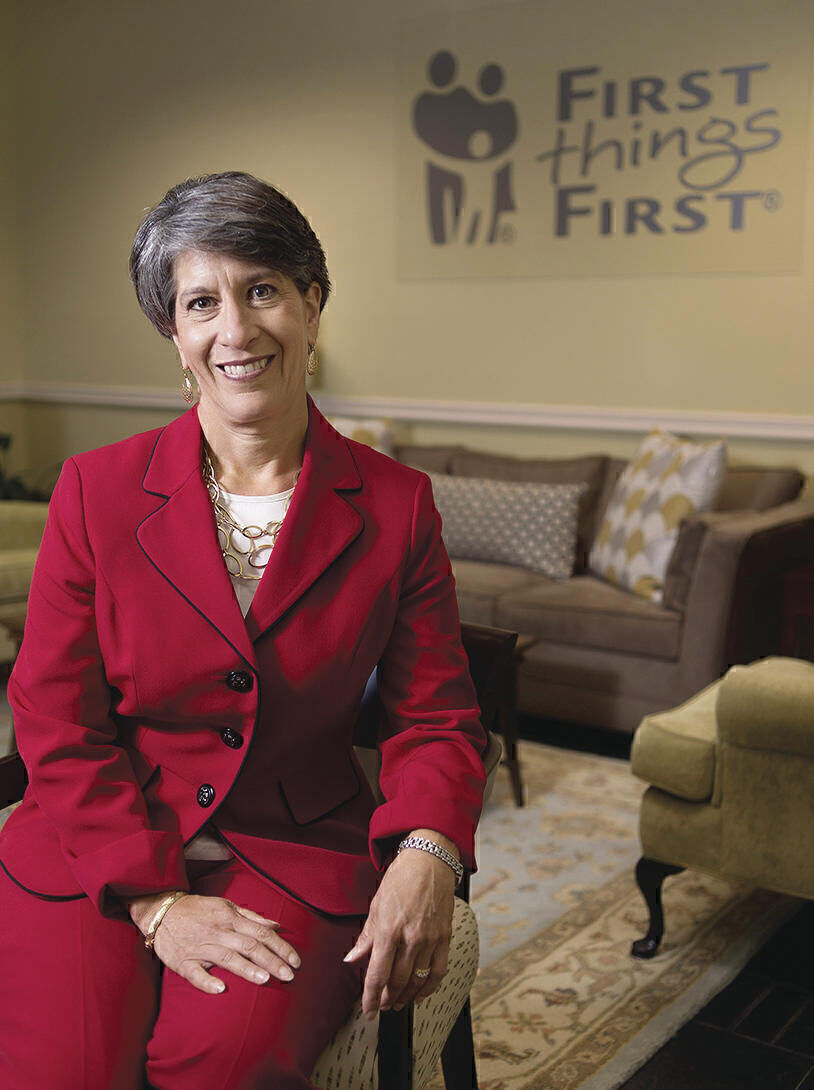
Virtually every class starts with the premise that most couples are not equipped to deal with the hard work and rough patches of relationships. “Many people enter marriage with an empty toolbox,” says Julie Baumgardner, the group’s president and a former family counselor with a master’s degree in community agency counseling. “They get into trouble, they hit a ditch, and they don’t know how to get themselves out. They yell louder. They use the silent treatment. They do what was modeled for them. And when it doesn’t work, they just say, ‘Well, if I had married the right person, we wouldn’t be arguing.’ ”
Couples lack skills to navigate marriage for many reasons, experts say. Among them: high rates of divorce and single parenting, which mean children often grow up without the model of a healthy marriage; the “hook up” culture among teens and young adults, which makes sex, rather than learning about each other, the cornerstone of dating; and the increasing withdrawal of Americans from civic, communal, and religious life, which limits meaningful social interactions.
“We’re living in silos and parenting in isolation,” says Gena Ellis, a teacher for First Things First. “The village is not teaching you how to parent and do marriage well. You’re on your own.”
In the class tonight, Ms. Robinson, who has a Ph.D. in child and family studies, works from a University of Denver curriculum, adding elements — including games and activities — she’s discovered in her college work and through 15 years of teaching for First Things First. Over two nights and eight hours, the class will talk about parenting, in-laws, finances, intimacy, and more. They will also consider what leads to domestic violence. Some women and men, Ms. Robinson says, are in an abusive relationship but don’t know enough even to recognize it.
Marketing Aggressively
First Things First launched in 1997 with two employees and ambitions to revitalize a city rebuilding after the collapse of its manufacturing industry in the 1960s and 70s. Today, it has burrowed into every nook and cranny of the city, working out of schools, public-housing projects, community centers, churches, hospitals, doctors’ offices, businesses, and hotels.
Ninth graders in the public schools take a unit on dating led by teachers from First Things First. For singles, there are classes on “How to Avoid Falling for a Jerk/Jerkette” and “Sex, Lies, and Relationship Drama.” Parents can get advice on raising babies, toddlers, grade-schoolers, or teens.
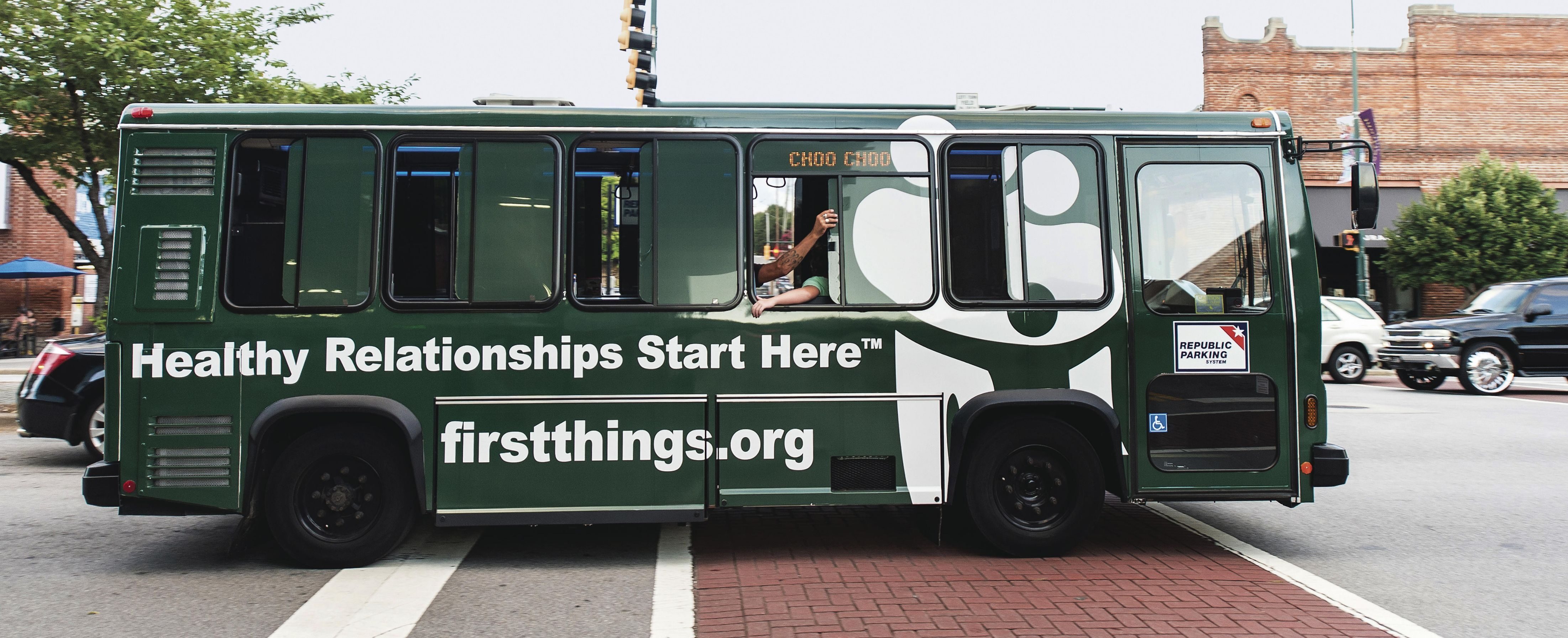
Ms. Baumgardner, who’s done stints in hospital marketing, leads an aggressive communications effort that puts First Things First’s name and classes on television, radio, billboards, bus placards, and even the local minor-league team’s ballpark. A former counselor who worked with adolescents, couples, and families, she has her own newspaper column and local public television show, platforms for dispensing research and advice.
This supersaturation of the media aims to do more than fill classes. The group implements citywide awareness campaigns akin to antismoking efforts; each ad features a sound bite to push behavior-changing ideas into Chattanooga’s collective conscious. One aimed at teens reads simply: “A baby costs $785 a month. How much is your allowance?”
Locally, First Things First has earned influence and credibility. For the past two years, it has been named the city’s “best nonprofit” in a Chattanooga Times Free Press readers poll, while Ms. Baumgardner has been a finalist in the “best Chattanoogan” category.
Nationally, First Things First is the clear leader in relationship education, according to Orit Avishai, a Fordham University sociologist who spent several days with the group as part of her research into the field. The group has quality teachers, outstanding services, and a program culturally attuned to working with low-income families. “This is best practices,” Ms. Avishai says.
Breakout Moment?
First Things First initially operated solely on private funding, but since 2006 it also has won federal funding through anti-poverty “marriage promotion” grants begun under President George W. Bush. Though social-service nonprofits and universities were among the grantees, critics pointed to the faith-based groups in the mix and argued that a paternalistic, Christian-right agenda was at work. (First Things First is secular, but many of its leaders and teachers have strong ties to local churches.)
That critique has faded over time, in part because President Obama’s administration has continued the funding. Today, with the culture wars over marriage fading, First Things First and similar organizations should be poised for a breakout moment. After all, they promise to strengthen marriage and family — exactly what thinkers on the left and right now point to as keys to income inequality.
Yet collectively, these groups are hamstrung by research that suggests they don’t deliver, especially for the poor and working class. Two studies of a sampling of programs (not including First Things First) concluded they do little to bolster families. One of the studies found only small positive effects on relationships; the other reported none.
To some, these studies are reason enough to pull the plug on federal relationship-education programs. These people say government should stop promoting the traditional family structure and do more to strengthen families of all types through income and job support, expanded child care, and a higher minimum wage — measures to ease the economic chaos that can destroy marriages and relationships.
Better yet, says Isabel Sawhill, a Brookings Institution scholar, government should promote long-acting, reversible contraception (typically implants and intrauterine devices). A privately funded experiment in Colorado to make so-called LARCs free for teenagers and low-income women has led to a dramatic decline in unplanned births.
Defenders of relationship education recognize their weakened position. They say federal research is seriously flawed: In one study, nearly half of participants didn’t show up for a single class. It’s acknowledged the field is spotty and some programs are still finding their way. And all groups aren’t all as strong as First Things First.
Alan Hawkins, a professor in the School of Family Life at Brigham Young University, says it’s too early to give up. “If we held early-childhood education up to the same standard,” he says, “we would have abandoned it 30 or 40 years ago.”
Extensive Studies
In the fall, the Obama administration will award new relationship-skills grants, with funding expected for five years. This time, the government is asking grantees to collect data for an extensive study of the programs — work that some hope will provide definitive answers.
First Things First will not seek a new grant. It plans instead to do more fundraising and introduce fees for classes for those who can pay. Private dollars have typically made up about half the $2-million budget, and Ms. Baumgardner is confident the organization’s work will attract more support. “We never intended to be dependent on this kind of funding forever,” she says.
First Things First has no doubt its brand of relationship education works. Its teachers relate stories of running into former class participants who exclaim: “You saved my marriage.”
The group’s class for married couples on the brink of divorce offers perhaps the best evidence of the group’s effectiveness. An outside research firm hired by First Things First contacted nearly 500 couples who attended the class over five years; 92 percent reported they had decided to work on their marriages and at least put divorce on pause.
David Banks, a marriage counselor for more than 20 years, began teaching the class five years ago. One couple, he remembers, approached him at the end of their last session and said they had recommitted to working on their marriage. The two had been so ready to give up that the woman had divorce papers tucked in her purse.
“Everything was signed and set to go,” Mr. Banks says. If things had not worked out in class, they would have headed straight to their attorney, who had an office in the same building, just a few blocks from the courthouse.