Mission Trumps Revenue for Catholic Sisters in Mo.

By Drew Lindsay
Senior Editor, Special Projects
August 29, 2016 | Read Time: 3 minutes
For years, the Franciscan Sisters of Our Lady of Perpetual Help, a congregation of Catholic sisters, organized an annual fundraising dinner and auction, with guests bidding on baskets of donated items.
No one worried much about the content of those baskets until last fall, when the sisters showed an environmental documentary for 100 or so people in St. Louis, where the congregation is headquartered. The film focused on the Great Pacific Garbage Patch, a large expanse of ocean that has collected tons of man-made debris, much of it plastics from fishing nets, bottles, and even computer monitors.
The auction was set for the following week, with baskets jammed “with stuff — a lot of plastic stuff,” says Sister Renita Brummer, one of the congregation’s leaders.
The situation was troubling. The congregation is known as the “green Franciscans,” thanks to its long commitment to caring for the earth. And its fundraising, the sisters realized, directly conflicted with its mission.
“The light went off,” Sister Renita says.
The next week’s auction became the last. Though the dinners raised as much as $100,000 a year, the sisters ended them in what Sister Renita calls “a challenging decision.”
“We traded financial equity for mission equity, which is a tough choice,” she says. “Mission equity is what we’re about, but it doesn’t put money into our retirement fund.”
New Focus
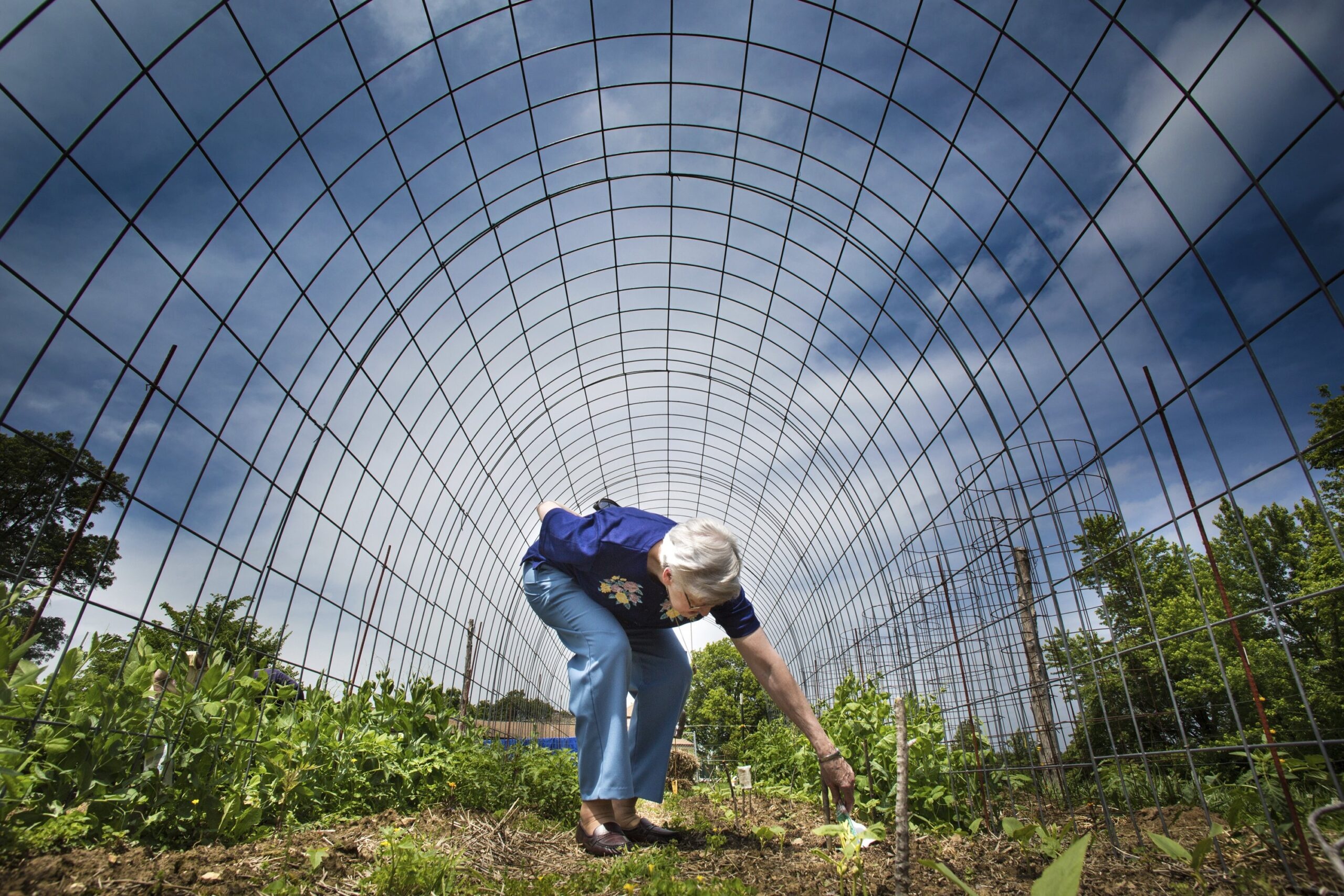
As they turned away from reliable revenue, however, the sisters discovered a new, invigorating focus. Doubling down on their environmental mission, the sisters decided to build a small demonstration garden on the 40 acres of rolling hills the congregation owns about an hour south of St. Louis. With volunteer help, they plant dozens of varieties of heirloom plants and tomatoes. Everything is grown organically, and harvests are donated to food pantries or sold at markets.
“This year, we had over 1,400 pepper and tomato plants sold at local food markets,” Sister Renita says.
The sisters often go to the markets and talk about the garden, and word has spread. Local politicians visited recently, and schoolchildren come to work the ground — an antidote to what Sister Renita calls “nature-deficit disorder.”
One group of kids helped harvest potatoes. “To see those children put their shovel in and turn that ground over and find those big potatoes — it was better for every one of them than an Easter egg hunt,” she says.
Susan Raymond, executive vice president of the consultancy Changing Our World, works with a number of women’s religious orders pressed to raise money. She says many own large tracts of property and are using the land in innovative, environmentally friendly ways that spin off new revenue. “People think of nuns as sitting in a chapel,” she says. “But they’re really doing interesting things.”
Sister Renita and the congregation have talked about raising money through catalog sales of their heirloom seeds. But for now, they want to focus on their expanded mission locally and their new connections in the community. They have replaced only about half the revenue from the dinner auctions through the garden sales and alternative fundraising.
“But we believe that if you are faithful to your mission, God will make up the difference.”