Overview: A Communications Plan That Promises Less Work but More Supporters

By Drew Lindsay
Senior Editor, Special Projects
February 1, 2018 | Read Time: 2 minutes
Joe Williams is the volunteer of nonprofit dreams. A few years ago, while he was working at a public-relations agency, his pro bono work for charities whetted his appetite to do more. A friend introduced him to Rebecca Butler, a staffer at Family Lifeline, a Richmond, Va., social-service group, and they met for a beer.
In short order, Williams, 29, joined the organization’s young-professionals group. Then he became president of the group. Then he joined the board. “I have fully invested, personally and emotionally,” he says.
Under Williams’s leadership, young professionals have energized Family Lifeline with new volunteers and a raft of strategic, innovative ideas. Notably, Williams and the group persuaded the board to reinvent its annual springtime luncheon as a “Spring Give,” complete with a first-ever direct request for donations. The newly branded event raised $28,000 in its first year.
Williams also has put his professional skills to work designing a communications strategy for the organization. “We had wanted a professional communications plan for a long time,” Butler says. “We hadn’t been able to come up with the money to hire a consultant.”
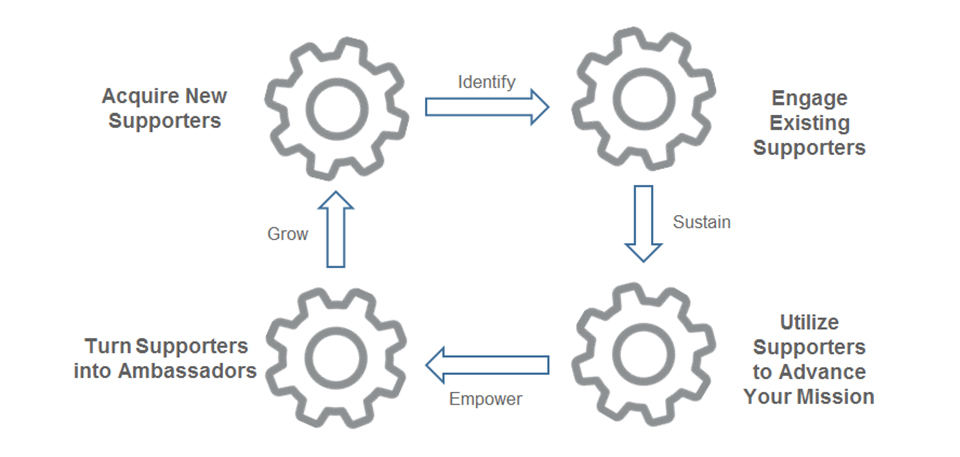
Williams gave Family Lifeline what he calls the “supporters gears” model. It suggests communications should focus on four tasks: acquire new supporters; engage them; use them to advance the mission; and then deploy them as ambassadors.
Williams has since talked about his communications model with other nonprofits. Too often, he says, groups focus on only one or two of the four “gears.” They often pour enormous effort into donor acquisition, for instance, but ignore supporters or don’t engage with them smartly.
Ultimately, the mature supporters who become ambassadors for the organization carry the weight of the work of acquiring new donors. “If you get all four gears going at once,” he says, “it becomes a cycle that feeds itself.”
Williams shares his outline of the gears model here, with details about a social-media strategy, comparisons to Apple and Starbucks, and more.